Explore the Data Mesh paradigm and how it enables domain-driven data ownership for scalable data architectures.
Is your data governance ready for domain ownership?
Get 90-Day DG RoadmapAs organizations scale their data operations, centralized data teams often become bottlenecks. Requests pile up, domain context gets lost in translation, and the people closest to the business wait weeks for a dataset they could have owned themselves. Data Mesh offers a sociotechnical approach that distributes data ownership to domain teams — without giving up enterprise standards.
That shift is not a new warehouse, a new catalog, or a new job title. It is a change in who is accountable for data, how products are published, and how governance is enforced. Organizations that treat it as a tooling project usually recreate the same central queue with extra metadata.
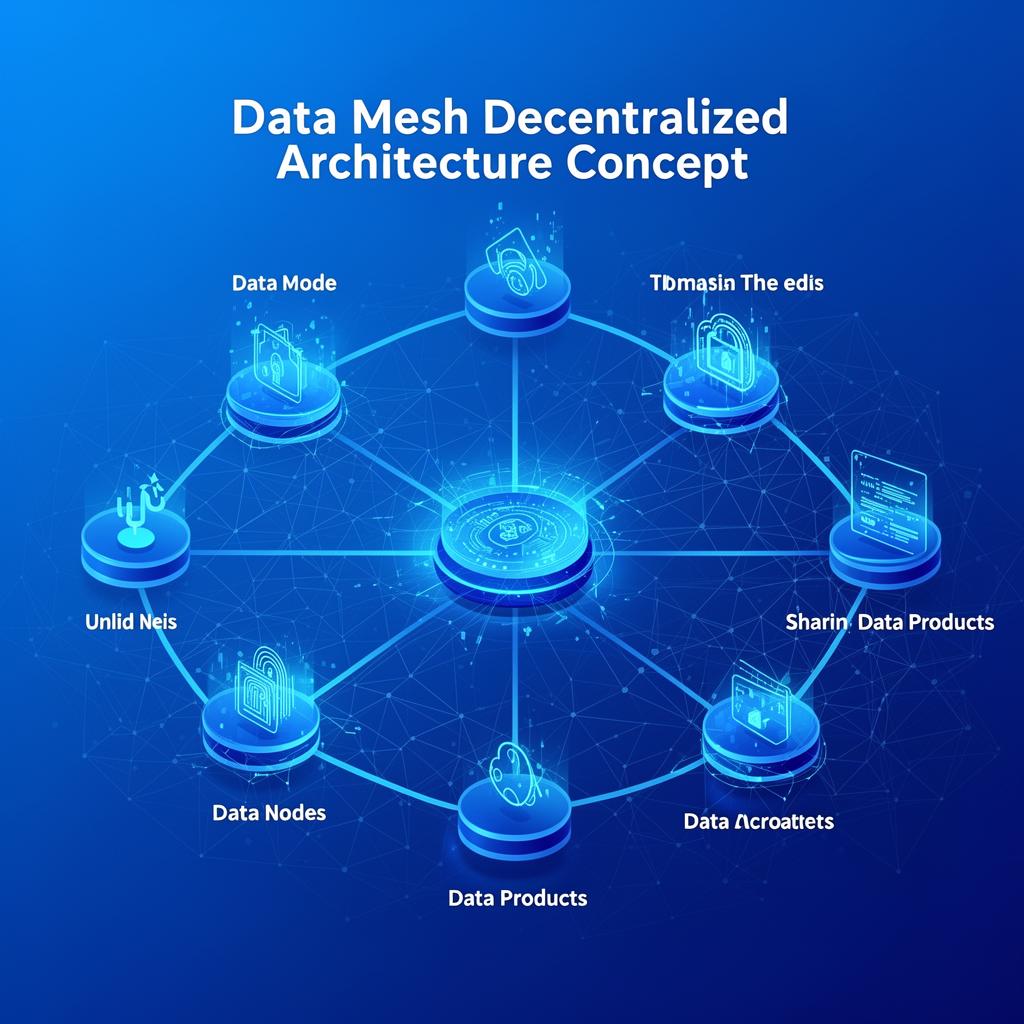
Why centralized data platforms stall
Most enterprises started with a sensible model: a platform team ingests source systems, models a warehouse or lake, and serves reports to the business. At a small scale this works. At dozens of domains, it breaks for predictable reasons.
A single team cannot hold the semantics of finance, supply chain, clinical operations, and digital products at once. When they try, pipelines become generic, definitions drift, and “the number” depends on who you ask. Quality issues are discovered by consumers, not producers. Every new product, market, or regulation adds work to the same backlog.
The result is a hidden operating cost: shadow spreadsheets, duplicated extracts, and analytics teams that rebuild the same logic because they do not trust the central model. Data Mesh starts from that failure mode. Instead of asking a central team to know everything, it asks each domain to publish data the rest of the company can use.
Core principles of a data mesh
Zhamak Dehghani’s original framing still holds. Four principles work together; skipping one usually recreates centralization or chaos.
1. Domain-oriented ownership
Each business domain owns and manages its data as a product, with dedicated people responsible for quality, availability, and meaning. Finance owns financial events. Supply chain owns shipments and inventory. The platform team does not become the interpreter of every source system.
Ownership has to be explicit. A domain data product owner, a steward, and the engineers who run the pipelines need a shared contract: what the product is, who consumes it, and what “good” looks like. Without that, “the domain owns it” becomes an unfunded mandate.
2. Data as a product
Data is treated as a product with clear SLAs, documentation, and discoverability — just like any software product. Consumers should find it in a catalog, understand the grain and freshness, know the owner, and integrate through a stable interface rather than a tribal Slack thread.
A useful data product typically includes:
- A well-defined dataset or API with schema and grain
- A business definition and example questions it answers
- Quality tests and a published freshness / completeness target
- Lineage back to source systems
- An owner and a support path when something breaks
3. Self-serve data platform
A platform team provides the infrastructure and tools that domain teams need to build, deploy, and manage their data products autonomously. Provisioning storage, compute, CI, access patterns, and observability should not require a six-week ticket.
The platform’s job is to make the right path the easy path: templates for pipelines, standard table formats, identity-aware access, and paved roads for publishing to the catalog. Domain teams still write the transformations. They should not have to invent a lakehouse from scratch.
4. Federated computational governance
Governance policies are defined globally but enforced locally through automation. Privacy, retention, naming, interoperability, and security standards stay enterprise-wide. Execution happens in the domain’s pipelines and catalogs, not in a committee that reviews every field.
This is the principle most organizations skip. Without it, mesh becomes a polite word for ungoverned copies. With it, you can scale ownership while still answering a regulator, an auditor, or a CIO who asks “who can see this, and why?”
What a data product actually includes
Teams often rename an existing warehouse table a “data product” and stop there. That does not change the operating model. A product is a contract between a producer and many consumers.
At minimum, define:
- Purpose — which decisions or processes this product supports
- Interface — tables, files, or APIs, including schema evolution rules
- Service level — freshness, completeness, and incident response
- Quality — automated tests that fail the pipeline, not a dashboard nobody watches
- Discoverability — catalog entry, glossary terms, and certified status
- Lifecycle — versioning, deprecation, and who approves breaking changes
Once those exist, consumers can build on top of domain products instead of reaching into raw source replicas. That is how you reduce duplicate modeling and the “which finance table is real?” debate.
The self-serve platform layer
Domain teams will not adopt mesh if publishing a product still means opening ten tickets. The platform should offer opinionated building blocks:
- Object storage and open table formats (Delta Lake, Iceberg, or Hudi)
- Orchestration and transformation (for example Airflow or Azure Data Factory with dbt)
- A metadata catalog with lineage, classification, and access requests
- Policy-as-code for PII, row filters, and retention
- Observability: freshness monitors, schema drift, and cost per product
- Infrastructure as code so a new domain can stand up a sandbox in hours, not quarters
StarNET typically implements this as a paved-road lakehouse with federated catalogs such as Unity Catalog, plus a business catalog (Atlan, Collibra, or equivalent) so products are searchable by people who do not live in Spark jobs.
The platform team’s success metric is not “number of pipelines we run.” It is how quickly a competent domain team can publish a reliable product without the central group becoming the runtime owner.
Federated computational governance
Central policy, local execution. That sounds abstract until you map it to real controls.
Global standards might include: every product has an owner, PII is classified, gold products have tests and lineage, and access is granted through identity — not copied files. Local execution means those rules are encoded in the catalog, in CI, and in the table format’s access model.
A federated council (architecture, security, privacy, and domain leads) sets the rules and the exceptions process. Domain stewards apply them. Automation blocks non-compliant publishes. Humans handle the edge cases.
This is also where data mesh and a 90-day governance roadmap meet. If you cannot name owners, classify sensitive data, or measure quality today, mesh will amplify the mess. Get the minimum viable controls in place, then federate.
When data mesh is — and is not — the right move
Data Mesh is a fit when you have multiple domains, competing definitions, and a central team that cannot keep up. It is a poor fit when the organization is small, the data estate is still a handful of sources, or there is no appetite to fund domain engineering.
It is also the wrong first move if you lack a usable platform. Mesh on top of brittle, undocumented ETL just distributes the outages. Sequence matters: stabilize storage and compute, stand up a catalog and quality baseline, then shift ownership domain by domain.
A useful test: can you name three domains that already feel the pain of waiting on a central team, and that have enough engineering capacity to own a product? If not, start with a better central platform and clearer product thinking — not a full mesh reorg.
A practical implementation path
Treat the first 90 days as a proof of operating model, not a company-wide rename.
- Pick one or two domains with clear consumers and painful bottlenecks — not the most political dataset.
- Define the product spec before writing new pipelines. Grain, SLA, tests, owner, and catalog entry come first.
- Give them a paved road on the existing lakehouse: a template repo, environments, and CI that publishes metadata automatically.
- Encode two or three global policies as automated gates (classification, naming, quality on certified products).
- Measure the old and new path — time to publish, incident count, duplicate datasets retired.
- Only then scale to the next domains, using the first products as the reference.
Expect organizational work: role design, funding for domain engineers, and a governance forum that actually decides. Technology follows that, not the other way around.
Conclusion
Data Mesh is a powerful paradigm for organizations struggling with centralized data teams. When implemented thoughtfully — products with contracts, a self-serve platform, and federated controls — it unlocks faster delivery and better quality because the people who understand the data own it.
Start with ownership and a paved road, not a new logo on the org chart. If you want a structured view of whether your governance model can support domain products, take the 90-day assessment and use the gaps as the first backlog.