🚀 Beyond the Upgrade: The DNA of Digital Transformation
In the boardroom of 2026, the term "Digital Transformation" is often used, but frequently misunderstood. Many leaders mistake it for a faster server, a move to the cloud, or a new CRM. However, these are merely modernizations.
True Digital Transformation is a metamorphosis. It is the process of an organization shedding its analog skin to become a data-driven, agile, and AI-native entity.
🏗️ Modernization vs. Transformation: Know the Difference
Think of your organization as a house. Modernization is like installing a smart thermostat and painting the walls; it’s an operational upgrade. Digital Transformation is tearing down the house and building a modular, solar-powered "living" structure designed for a completely different way of life.
Comparison Table: The Strategic Divide
| Feature | IT Modernization / Upgrade | Digital Transformation |
|---|---|---|
| Focus | Efficiency and Cost Reduction | Value Creation and New Business Models |
| Scope | Specific systems or departments | The entire organization & ecosystem |
| Goal | Doing the same things, but faster | Doing things we couldn't do before |
| Duration | Project-based (Start/End) | Continuous evolution |
| Risk | Managed, low disruption | High risk, high reward, cultural disruption |
🧠 The Cultural Engine: Transformation starts with "People"
Technology is the easy part. Changing the collective mindset—the Culture—is the real challenge. Without a cultural shift, new tools are simply expensive "paperweights" for old habits.
- From Hierarchy to Agility: Decision-making must move from the "Highest Paid Person's Opinion" (HiPPO) to data-driven autonomy at the front lines.
- A "Fail Fast" Mindset: Transformation requires a culture where experimentation is celebrated and failure is viewed as a data point, not a career-ending move.
- Continuous Learning: In 2026, the half-life of a technical skill is less than 2.5 years. Organizations must become "Learning Machines."
"Culture eats strategy for breakfast, but in the digital age, culture is the strategy."
⚙️ Industrial Revolutions: The AI Tsunami
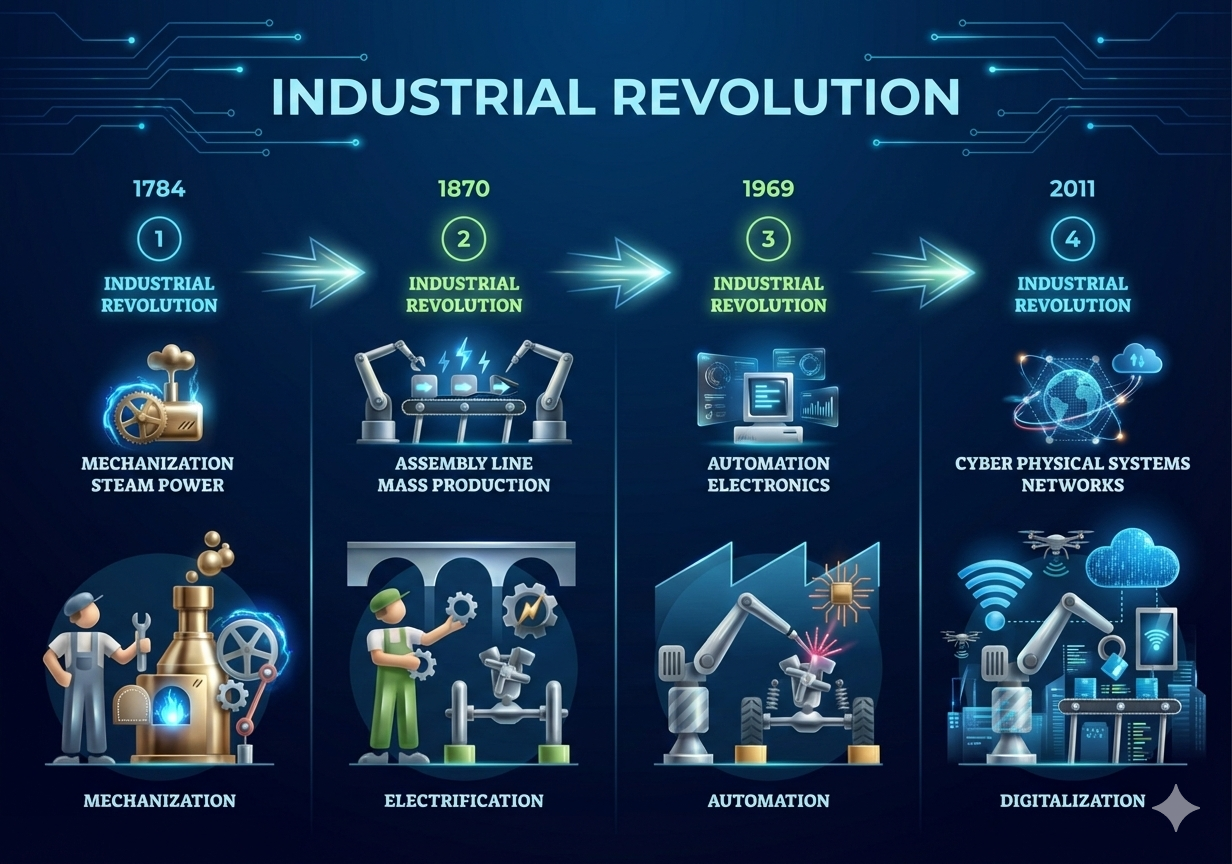
We are currently navigating the 4th Industrial Revolution (Industry 4.0), where the physical and digital worlds blur. However, the emergence of Agentic AI in 2026 is pushing us toward Industry 5.0—focused on the collaboration between human creativity and machine intelligence.
The Evolution of Impact
- Steam & Water: Mechanical production.
- Electricity: Mass production.
- Electronics & IT: Automated production.
- Cyber-Physical Systems: Smart automation.
- Cognitive AI (Now): Collaborative Intelligence.
Why AI is Different
Previous revolutions automated muscles and repetitive tasks. The AI revolution automates cognition.
- Reactive to Predictive: Organizations no longer ask "What happened?" but "What will happen next?"
- Tools to Partners: AI is no longer a "software you use" but an "agent you manage."
- Hyper-Personalization: AI allows a billion-dollar company to treat every customer like a segment of one.
🔮 The 2026 Organizational Blueprint
The organization of the future doesn't just use AI; it is built around it. This involves a shift from siloed departments to "Digital Threads"—interconnected data streams that link R&D, Supply Chain, and Customer Experience in real-time.
Key Shifts for 2026:
- The Rise of AI Agents: Autonomous agents now handle complex workflows (e.g., procurement and dynamic scheduling) without human prompts.
- The Zero-Latency Enterprise: Information travels through the organization at the speed of light, enabling "Instant Pivots" in response to market shifts.
✅ Summary Checklist for Leaders
- Stop asking for an "IT Roadmap" and start asking for a "Business Evolution Strategy."
- Audit your culture: Is your team empowered to experiment with AI without fear of failure?
- Identify "Legacy Mindsets" that are more dangerous than legacy software.
- Move from "Efficiency" metrics to "Adaptability" metrics.